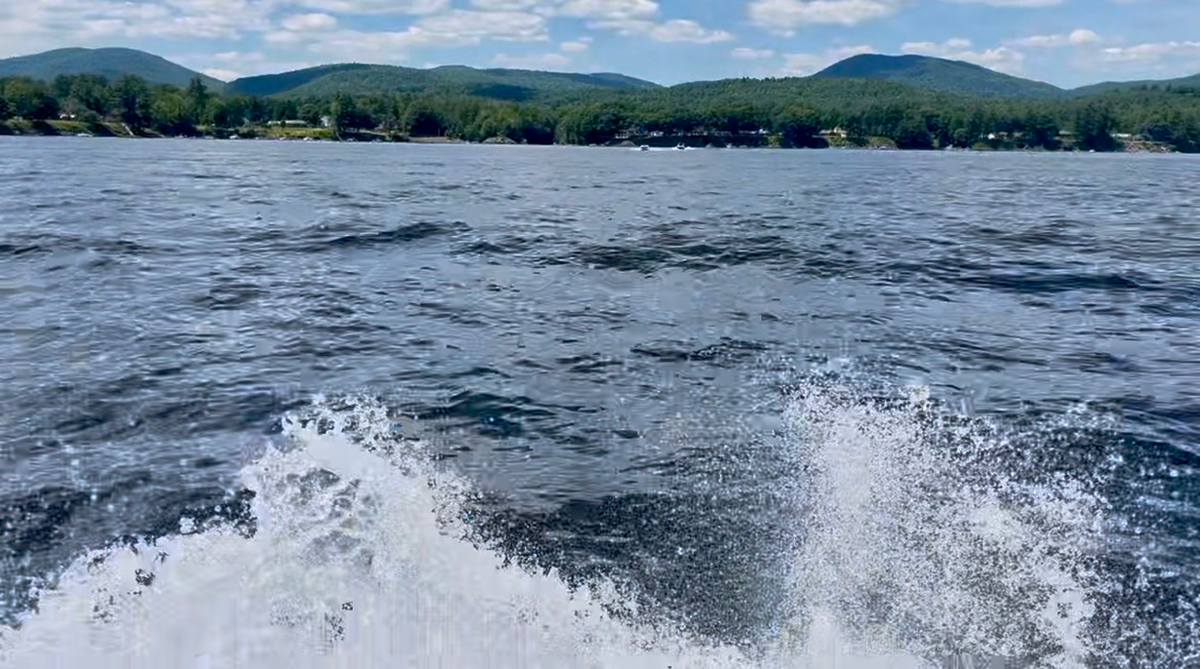
Wake boats, when used for wake sports, create large waves
Summer is in full swing and that means many types of water-based activities are taking place on Adirondack lakes. Wake sports are emerging in the Adirondacks as a new source of adverse environmental impacts on wildlife, shorelines, lake bottoms and aquatic vegetation. The wake sports are increasing in popularity in the Adirondacks. These watersports are performed with specialized wave-producing boats called wake boats that, when used in “wake mode,” generate large standing waves that allow wake surfers to surf behind the boat without a tow rope. Wake boats operate by having the stern pushed down, causing water to be forced towards the bottom of the lake.
We are working with a group of organizations around the Adirondack Park to learn more about the adverse impacts caused by wake boats, to educate the public on wake boat usage, and to encourage the public to become part of the solution to reduce the impacts and keep our Adirondack water bodies safe and protected. The Adirondack Wake Boat Working Group is a collaboration of the Adirondack Lakes Alliance, Paul Smith’s College Adirondack Watershed Institute, the Adirondack Center for Loon Conservation, Adirondack Council, Upper Saranac Foundation, and Protect the Adirondacks.
Adverse Impacts of Wake Boats
The presence of wake boats on lakes in the Adirondacks is causing growing concerns among waterfront property owners, lake stewards, naturalists and fellow boaters because of the environmental and safety impacts of wave-producing watercraft on fragile freshwater lake ecosystems. Research in other areas of the country have already demonstrated the adverse impacts of wake boats on a lake’s aquatic ecosystem, the shoreline, and other recreational users. Vermont recently updated its rules on wake boat usage, effective June 2026, to protect natural resources and public safety.
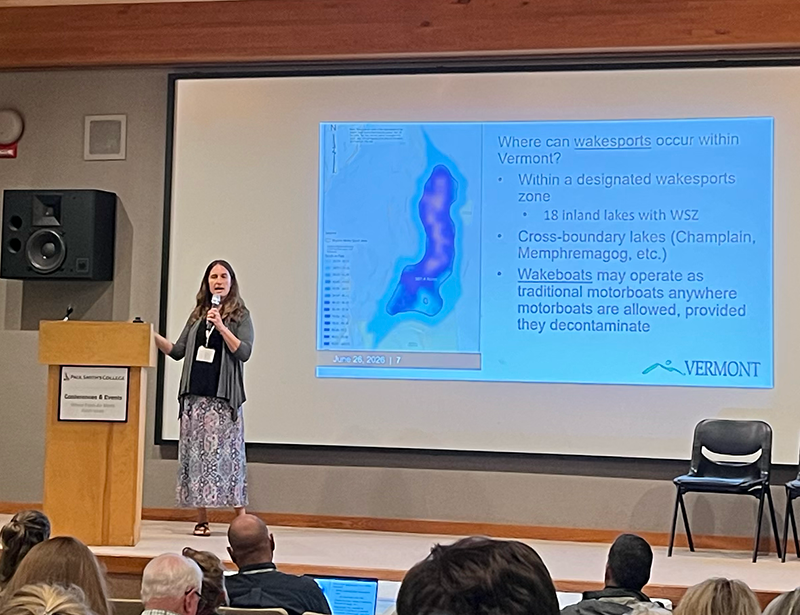
Laura Dlugolecki from Vermont’s Department of Environmental Conservation speaking at the 2026 Adirondack Lakes Alliance Symposium about Vermont’s wake boat restrictions.
The waves created by wake boats operating in “wake mode” are larger and stronger than the waves from other motorboats and have a greater potential to erode shorelines, damage shoreline structures (e.g., docks, boathouses) and moored boats, disturb wildlife (including nesting loons on the shore), uproot vegetation that fish and birds use for habitat, and suspend lake bottom sediment and nutrients. The suspension of sediment and nutrients negatively impacts water quality, water clarity, and can lead to the formation of harmful algal blooms (HABs) that can pose a danger to humans and animals.
The waves from these boats can also increase the risk of injury to swimmers and other boaters, particularly those using nonmotorized watercraft. Smaller boats can be swamped, broached, capsized, or pushed into docks or rocks by steep waves from wake boats. All of these can increase the risk of injury or drowning for the people onboard other boats who may be thrown about their boat or even thrown overboard.
The large ballast tanks filled with water are also a potential vector for transporting aquatic invasive species if the tanks are not clean, drain and dry when they travel from one lake to another.
More background information about wake boats is available in a recorded webinar available here. The webinar explains how wake boats are different from other motorized watercraft, provides a brief overview of research about the environmental impacts of wake boats, and offer avenues for responsible wake boat use. The presentation was delivered by Scott Ireland, Executive Director of Adirondack Lakes Alliance. He was joined by special guest Laura Dlugolecki from Vermont’s Department of Environmental Conservation. She played a key role in enacting wake boat restrictions for Vermont lakes in 2024 and in 2026.
Gathering Data in the Adirondacks
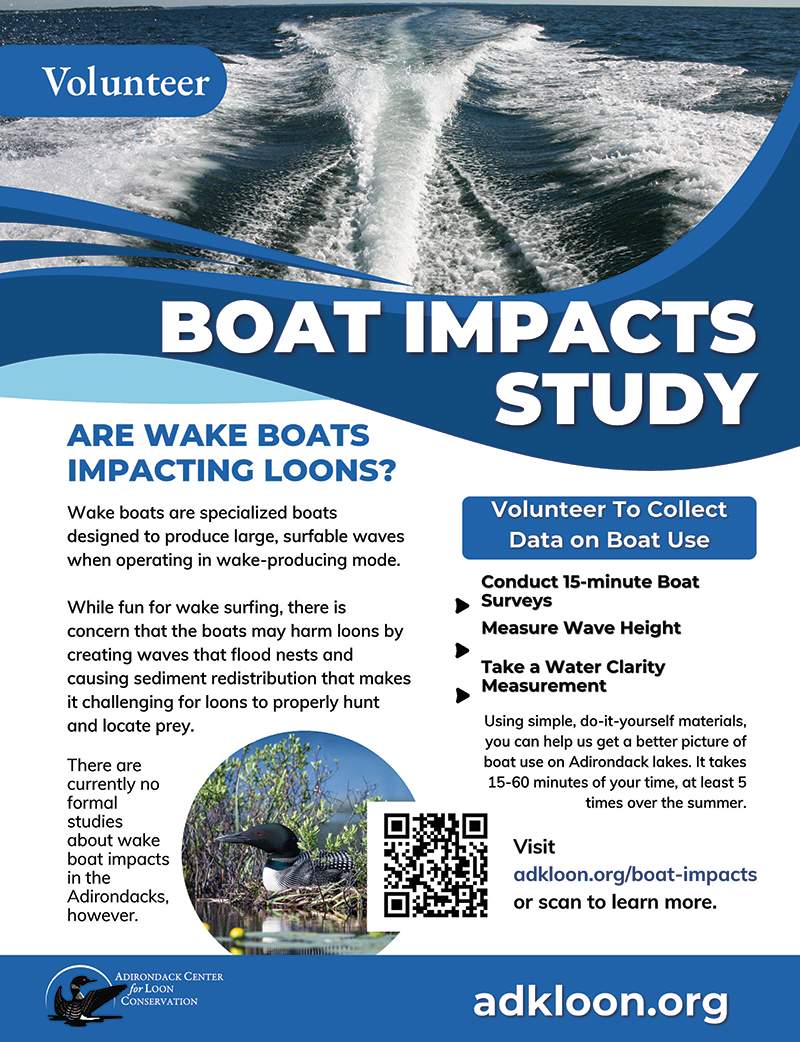
The Adirondack Center for Loon Conservation is conducting a Boat Impacts Study to gather more information about the impacts of wake boats on water bodies in the Adirondacks. Volunteer community scientists are needed to help collect data on the number of boats observed and to categorize observed boats into four categories. Volunteers will also note wave height during the boat surveys, and after the surveys they will take a water clarity readings. Learn about the survey and sign up to volunteer here: https://www.adkloon.org/boat-impacts.
The Adirondack Watershed Institute has also been gathering data on wake boats in the Adirondacks through its Lake Stewardship Program. This information should be available soon.
Steps to Reduce Wake Boat Impacts and Improve Safety
The impacts of wake boats can be reduced through voluntary and regulatory programs. Science and boat management practices indicate that wake boats should operate in wake boat mode in water that is at least 30 feet or more deep, and that they should operate in wake boat mode 1,000 feet from the shoreline, docks and other users to best minimize their impacts. In addition, wake boats need to ensure that they are clean, drain and dry between outings as already required by State law (Environmental Conservation Law § 9-1710).
The Upper Saranac Foundation started a new Wake Smart initiative to encourage wake boaters to have a heart and be wake smart. This initiative seeks voluntary compliance with setback and depth requirements for operating wake boats away from shorelines and shallow waters to reduce their impacts.
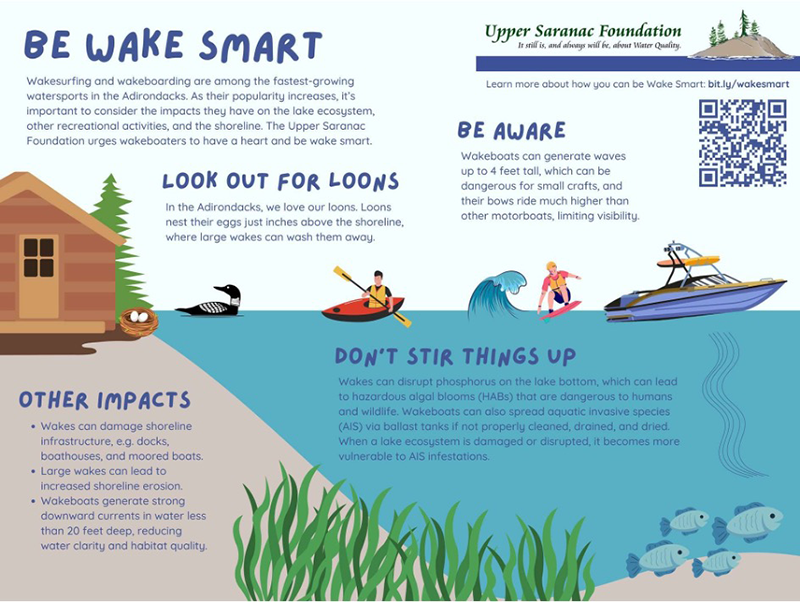
Flyer about Upper Saranac Lake Foundation’s Wake Smart initiative
Local towns are empowered by New York State Town Law § 130(17) to regulate the speed and operation of watercraft within 1,500’ of their shorelines. Further, Municipal Home Rule Law § 10 allows towns to enact local laws and regulations to protect the health, safety, and welfare of their residents. Accordingly, towns in the Adirondacks can adopt local laws establishing, out to a distance of 1,500 feet, where wake boats are allowed to operate and where they are not allowed to operate. One of the first steps in adopting a local law is for the Town Board to introduce the draft local law and set a public hearing. Local municipal officials should contact their Town attorney for advice on introducing a draft local law. A draft local law, with accompanying resolution for adoption, that can be considered by municipalities is available here. This is a draft and can be amended by the Town Board to fit the needs of the municipality. Again, local officials should contact their Town attorney to review the draft and to guide the municipality through the steps needed to properly pass the local law.
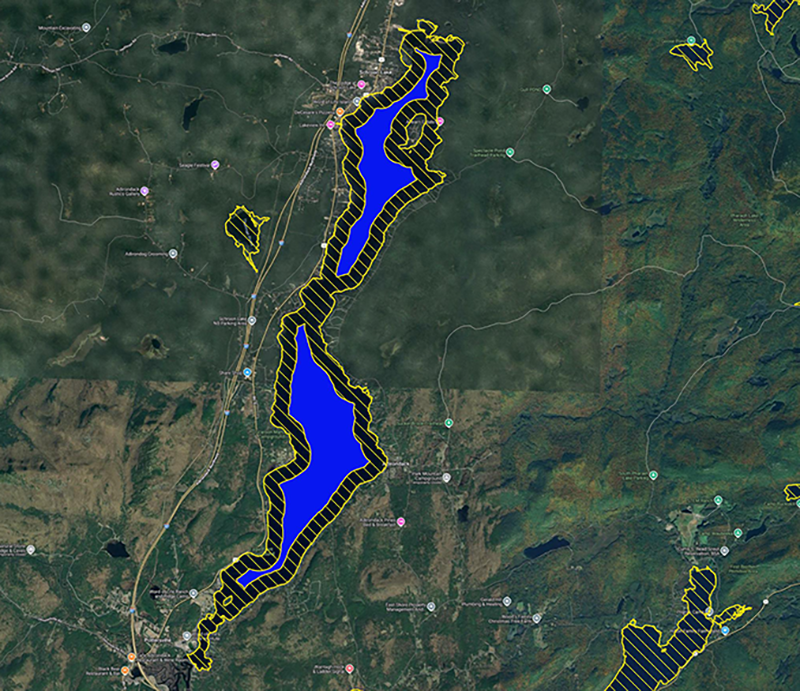
Map of Schroon Lake, located in the Towns of Chester, Horicon and Schroon, showing 1,000′ setback zones with the hatched yellow markings, and areas beyond that distance in blue.
For some lakes, such as those smaller than 60 acres or with no areas deeper than 30 feet or that have very little area more than 1,000’ from the shoreline, it may be appropriate to consider a local law that prohibits wake boat operation entirely.
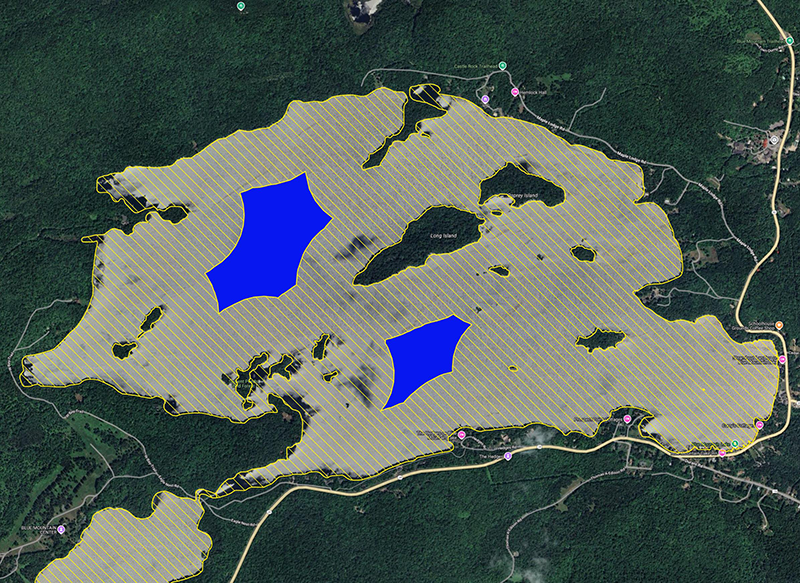
Map of Blue Mountain Lake, located in the Town of Indian Lake, showing 1,000′ setback zones with the hatched yellow markings, and areas beyond that distance in blue. Inside the blue areas there are shallow spots that would be dangerous for operating wake boats for wakesports. Therefore, this lake may be considered to have no areas that are appropriate for wake boat operation.
For lake associations or other organizations seeking to encourage their towns to adopt a local law regulating wake boats operating in Adirondack lakes, a draft resolution in support is available here.. The association/organization can formally adopt the resolution through its governing board/body and then submit the resolution to the Town Board along with a copy of the draft local law (above) to encourage the Town to take action to reduce wake boat impacts and improve boating safety.